








Copyright © 2006 Ransoms Garden Centre Ltd, Jersey, Channel Islands Inc. All rights reserved
Designed by Stewart Redway Ltd
Plant of the month
Hardenbergia Violacea
Purple Coral Pea
This plant is in the leguminosae family of pea family and a native of Australia. Named after Franziska Countess von Hardenberg, a 19th century patron of botany, and the violacea is after the violet colour of her blooms.
It seems to love life in Jersey and flowers without fail from winter through to spring. The flowers are arranged like miniature Wisteria flowers and are a gorgeous lilac purple colour.
The plant is a hermaphrodite and has the ability of many leguminosae, to fix nitrogen, this means it requires less food than many other plants. It prefers a slightly acidic but free draining soil and will tolerate semi-shade through to light sun. SEE>MORE
Winter and early Spring is the time to think about pruning many plants in the garden. However, never prune for the sake of pruning, prune only the plants that need pruning. Roses are a good example of plants that need pruning to get the best results.
Tools You'll Need
Sharp Secateurs
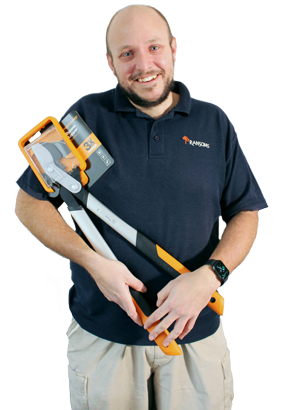
Long-handled Loppers
Thick Gloves
The “3Ds” Remove all Damage, Dead or Diseased wood.
When starting use clean, sharp tools and look at the overall plant, begin pruning from the base of the plant. Prune to open the centre of the plant to light and air circulation you prune or cut, hold your secateurs in such a way that the best cut is left behind. Don’t use secateurs that tend to crush the stem as they cut.
The cut angle should be 45 degrees so that it slopes slightly back and away from the bud. In this way any moisture forming on the stem will run away. The bud should also face outward. Be careful not to make your cut too close to the growth bud. It is also wrong to make it too far from the bud. The cut should be 4 to 5 mm above a bud that is facing toward the outside of the plant. When you remove a complete stem, use sharp secateurs to cut them as close to the main stem as possible. Trim the stem with a sharp knife flush with the main stem. Watch out that you don’t damage the main stem when pruning roses. Larger stems may be trimmed with Long-handled Loppers. Remove sucker growth below the graft.
HYBRID TEA ROSES - these are the large flowering varieties. Early February or March is the time usually set aside for pruning roses. Prune these roses back to three to five of the strongest (young) canes. Then shorten the canes in this manner. Any cane that is the size (diameter) of pencil, prune back to 10cm to 20cm from the ground; canes the size of your little finger prune back to 20cm to 30cm inches from the ground; and canes the size of your forefinger should be pruned back to 30cm to 45cm from the ground. Any of the larger canes, thumb sized or larger, prune them back to two feet or less, if possible.
FLORIBUNDA ROSES - these are the bushy small flowering type roses. Simply head the bushes back to about 35cm to 45cm from the ground. Thin out a few of the canes for good air circulation and better light exposure.
CLIMBING ROSES - limit them to four to eight canes. Prune out old canes and keep the younger, lighter green colored canes. Train them against a wall, fence or on a trellis. Climbing rose canes have a tendency to grow upward, pull them down and train them outward so as to open-up and space the canes. This procedure should result in a lot more flowers and a much better looking plant.